
I keep seeing a version of the same post show up on the trading and quant subreddits, and every time it's smarter than the last one, which is exactly why it's worth writing about.
The one that stuck with me this month was from someone doing a PhD in computational biology, no live trading experience, but clearly someone who'd actually read the literature: order book modeling, market microstructure, how the big firms make their money. The core question was good and honest: can retail algo trading actually beat a long-term buy-and-hold S&P 500 position, and if it can't, is it even worth doing? Their gut instinct was pulling them toward statistical arbitrage, the idea of finding "near-stationary signals" hiding inside markets that are mostly non-stationary noise. Smart framing. Then they edited the post a few hours later, one line: "okay I think I didn't realize statistical arbitrage was something HFT. My bad."
That edit is the whole post in miniature. A genuinely capable, quantitatively trained person almost talked themselves into competing on exactly the ground where retail cannot win, caught it mid-sentence, and walked it back. The instinct that led there is the same one that quietly wrecks most retail algo traders, including the ones who never catch the mistake.
The belief that gets smart people into trouble
Here's the misconception, and I'd bet a meaningful chunk of people reading this hold some version of it: profitable algo trading is mostly about finding a better strategy or a smarter signal than everyone else is using. If you're clever enough, read enough papers, model the order book precisely enough, you'll find the thing others missed and that becomes your edge.
It's a flattering belief because it rewards exactly the skills a PhD student has in abundance: rigor, patience, the ability to sit with a hard math problem until it gives something up. It's also mostly wrong for retail, and the edit in that Reddit post shows why. Statistical arbitrage, the specific thing they were drawn to, near-stationary pricing relationships hiding inside noisy markets, is precisely the kind of signal that gets found and arbitraged away in microseconds by firms with colocated servers next to the exchange's matching engine. I went through the full mechanics of that gap in the quant firm tier list post: rebates, colocation, proprietary order flow, balance sheets that make retail capital look like rounding error. I won't re-run that whole argument here, it's one paragraph's worth of context and then we move on, because that's not actually the interesting question this Reddit post raised.
The interesting question is the one buried underneath: if the clever-signal approach is off the table, is retail algo trading worth doing at all, or should everyone just buy VOO and walk away?
The S&P 500 is a genuinely high bar, not a strawman
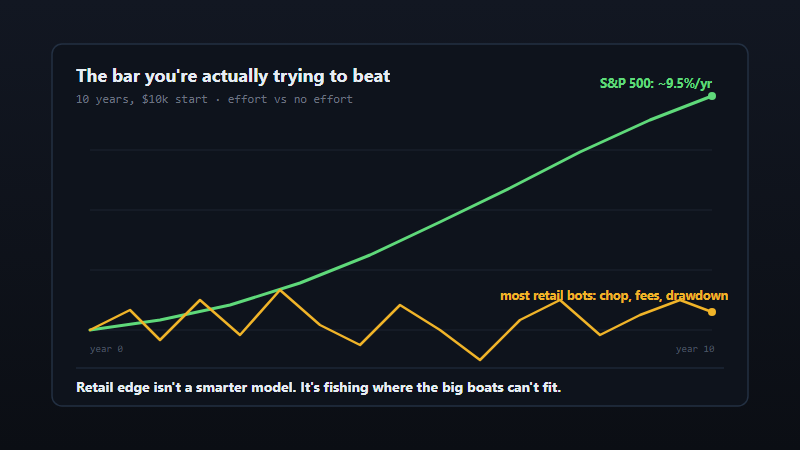
A lot of bot marketing treats "beat the market" as a throwaway line, and the benchmark deserves better than that. Pulling the long-run numbers from NYU Stern's historical S&P 500 return dataset, the index has compounded at roughly 9.5% a year since 1928, dividends reinvested, through the Depression, multiple crashes, and two decades that each felt like the end of the world at the time. That number costs you nothing to earn beyond patience and the discipline not to sell during the scary parts.
And it turns out even professionals paid to beat it mostly don't. S&P Dow Jones Indices' SPIVA scorecard found 79% of active large-cap U.S. equity fund managers underperformed the S&P 500 in 2025 alone, and the longer the window gets, the worse it looks: 89% underperformed over five years, 93% over twenty. These are people with Bloomberg terminals, research teams, and career incentives to find an edge, and most of them still can't clear a bar you can clear by doing nothing.
So when someone asks "can my grid bot beat the index," the honest answer is: almost certainly not, if you're comparing risk-adjusted long-term compounding against a strategy that's actively fighting fees, funding, and its own drawdowns every week. Work the mechanics and it gets worse, not better. OKX's futures grid bot stops earning entirely once a trend breaks the range, while funding keeps compounding on the stuck position, so its bad weeks are structurally worse than its good weeks are good. Pionex's futures grid has the cheapest fees of the group and still hands most of a low-leverage return back to funding. Neither design, costed honestly with the dead stretches included, is obviously beating 9.5% a year for zero effort.
If the question is "will my bot beat a boring S&P 500 index fund over ten years," the honest answer for most retail algo strategies is probably not, and anyone selling you a bot that promises otherwise is selling, not testing.
So why bother at all
Here's where the Reddit poster's edit becomes useful again, because catching that stat-arb was HFT territory doesn't mean giving up on algo trading, it means asking a different question: not "what's the smartest signal," but where can a small, patient, non-institutional account actually operate that a billion-dollar firm structurally can't be bothered with?
This is the reframe that matters, and it's the part most retail traders skip straight past on their way to buying another indicator pack. Big firms need strategies that scale to hundreds of millions of dollars, because that's the only way their fixed costs (the research team, the compliance department, the office lease) pencil out. That requirement quietly rules out an entire category of opportunity: markets too small, too illiquid, or too irregular to absorb serious institutional size without moving the price against yourself. A strategy that nets a firm 40% a year on $2,000 isn't a strategy a $5 billion fund will ever run, not because it doesn't work, but because there's nowhere to put the size.
Retail's actual edge lives in that gap. Smaller-cap altcoin pairs where the order book is thin enough that a fund moving real size would blow through it, but where a few thousand dollars slides in and out without leaving a mark. Specific market regimes, like the low-liquidity weekend hours or holiday periods where big desks are running skeleton crews and spreads widen. Longer holding periods that don't fit a fund's quarterly reporting cadence but suit someone who doesn't answer to investors. Structural quirks, like a specific exchange's fee rebate schedule or a funding rate mechanic that only matters at small size because at large size the arbitrage gets crowded out instantly, the way I found happens with funding rate arbitrage once you look past the headline yield number.
None of that requires a better model than Citadel's. It requires fishing somewhere Citadel's boat physically can't fit.
| Feature | Where retail structurally can't win | Where retail structurally can win |
|---|---|---|
| Market type | Deep, liquid majors: BTC, ETH, large-cap equities | Thin order books: small/illiquid altcoin pairs |
| Signal type | Microsecond stat-arb, latency-sensitive signals | Slower structural or behavioral inefficiencies |
| Time horizon | Sub-second to minutes | Hours to weeks, doesn't fit fund reporting cycles |
| Why firms ignore it | N/A, this is their home turf | Can't scale a $100M book into it without moving price |
| What you need instead of a smarter model | Colocation, rebates, PhDs, capital | Patience, market selection, honest fee math |
Why most retail algo traders lose anyway
If the niche edge exists, why do most people still lose money running bots. I'd guess it's not because the niche doesn't exist, it's because people don't fish there. It's much more exciting to build a bot that trades BTC/USDT on Binance, the most liquid, most efficient, most heavily arbitraged market on the planet, than to spend a month figuring out which mid-cap pair on a second-tier exchange has a structural quirk worth exploiting. The exciting market is exactly the one where you're competing with the firms from that tier list. The boring market is where the actual room is.
I'm not going to pretend I've cracked this myself, either. My own bot, which I've been documenting honestly in the build-in-public journey series, started on major pairs for the same reason everyone does: more liquidity feels safer, more data feels more testable. Some of the harder lessons in that series, the survivorship bias post and the regime filtering work, came from slowly realizing that the strategy needed to know when it had no business trading at all, which is really a market-selection problem wearing a different hat. I don't have a finished answer on where my own bot's true structural niche is yet. I have a better sense of the question than I did six months ago, which is honestly most of what this whole project has produced so far.
Back to the PhD student's question
So, is algo trading actually profitable for retail? Yes, genuinely, but not the way the original framing set it up. It's not profitable because a sufficiently smart person can out-model the order book better than a firm with a research budget in the tens of millions. It's profitable, when it is, because someone found a corner of the market too small, too slow, or too structurally awkward for the big money to bother competing in, and then had the patience to run a mediocre-looking strategy there for long enough to let the edge compound. A boring strategy in a niche nobody wants beats a brilliant strategy in a market everyone's already fighting over.
Beating the S&P 500 outright, risk-adjusted, over a full decade, is still a genuinely hard bar, and I'd rather tell you that upfront than sell you a dashboard screenshot from someone's best three months. Most retail bots don't clear it. The honest reason the ones that do tend to clear it isn't smarter math, it's access to a corner of the market the index and the firms both happen to ignore.
That edit the Reddit poster made, catching themselves before diving into HFT territory, is worth more than most of the strategy papers they'd read. It's the single cheapest lesson in this whole post, and it costs nothing to learn it before you deploy real money instead of after.