
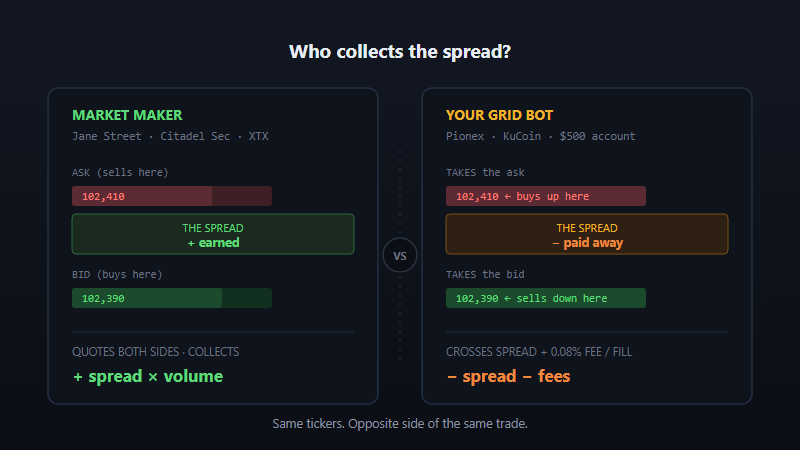
Your grid bot and Jane Street are looking at the same BTC order book, on the same exchange, at the same moment. So why does one of them reliably make money and the other one mostly doesn't?
The answer most people reach for is "they're smarter" or "they have better algorithms." Both sound right. Both are basically wrong, and believing them is what keeps retail traders chasing the wrong thing.
Someone posted a tier list on Reddit last week ranking quant trading firms by prestige: Renaissance, Jane Street, and Hudson River Trading in S-tier, Citadel Securities, Jump Trading, and XTX Markets one notch below, then D.E. Shaw, Two Sigma, Optiver, Point72, SIG, IMC, and DRW filling out A-tier, all the way down to GTS and Wolverine in D. The poster's stated methodology, and I'm quoting this because it matters: "personal opinion based on consensus gauged online plus speaking with quant alumni at my university." That's it. That's the methodology.
I went down the rabbit hole for an hour anyway. Not to argue Two Sigma deserves A-tier over Millennium (I have no idea, and honestly neither does the original poster). The tier list is vibes, alumni anecdotes, and survivorship bias dressed up as a ranking. But it's useful for one thing: it makes visible a belief a lot of retail traders quietly hold, which is that these firms are running a smarter version of the strategy you're running, and if you just tuned your bot better, read more, found the right indicator, you'd be doing a small-scale version of the same thing.
You wouldn't. Not because you're not smart enough. Because it isn't the same activity.
Why these lists always disagree with each other
Look up three different "top quant firms" rankings and you'll get three different orders. That's not because the rankers are lazy, it's because there's no shared metric underneath any of it. Compensation, research prestige, technical difficulty of the interview, how "cool" the strategies sound at a career fair, all get mashed into one number with no weighting scheme anyone agrees on. A finance PhD ranks by research depth. An undergrad ranks by comp and brand name. A trader ranks by autonomy. Same firms, three different orders, all defensible.
Which tells you what these lists actually measure: which firms ambitious students want to work at. That's a real question. It's just not your question. Yours is whether any of these firms knows something, or has something, you could copy on a $500 account. The tier list never asks it, so let's ask it.
The real gap: colocation, rebates, and who collects the spread
Here's the answer to the question I opened with, and it has nothing to do with anyone being smarter. Most of the S-tier and S- names on that list, Jane Street, HRT, Citadel Securities, XTX Markets, Optiver, IMC, are market makers. Their core business isn't picking direction. It's quoting a buy price and a sell price on both sides of a market simultaneously and pocketing the difference, over and over, at massive volume. Wikipedia's overview of market making puts it plainly: a market maker's income is the spread between the bid and the ask, collected as a byproduct of providing liquidity, not from predicting where price goes next.
That's the exact opposite of what a retail grid bot does. Your Pionex or KuCoin grid bot is a liquidity taker dressed up to look like a market maker: it buys and sells around a range, but it pays the spread and the trading fee on every single fill, it doesn't collect one. I went through this fee math line by line in the KuCoin bot review: a spot grid bot paying 0.08% per fill across a few dozen fills a day is racing its own transaction costs before it's made a cent of grid profit. A real market maker at a firm like Jane Street is on the other side of that exact trade, earning the spread your bot is paying away.
Then there's the infrastructure gap, which isn't subtle. These firms pay for colocation, literally renting rack space inside the same data center as the exchange's matching engine, to shave the round-trip time on an order down to a few hundred microseconds or less. Wikipedia's page on high-frequency trading even covers firms building microwave transmission networks between financial centers because microwaves through air travel faster than light through fiber optic cable, over a distance of hundreds of miles, to save single-digit milliseconds. Nobody is doing that to run a spot grid bot on their laptop. Add in negotiated fee rebates that scale with volume nobody at retail size will ever hit, proprietary order flow data, balance sheets in the billions, and rooms full of PhDs building the execution stack, and the honest picture is: retail bots and market-making firms aren't playing a harder or easier version of the same game. They're playing different games that happen to use the same tickers.
A retail grid bot pays the spread on every fill. A market-making firm collects it. That one sentence is the entire structural gap between "the tier list" and your trading account, and no amount of clever bot configuration closes it.
One more distinction worth getting right, because lumping these together is a common mistake: not everyone on that list is even doing the same job. Citadel Securities, Jump, XTX, Optiver, IMC, DRW, Virtu, and Flow Traders lean heavily market-making and high-frequency execution. D.E. Shaw, Two Sigma, Millennium, and Point72 are hedge funds running longer-horizon directional and statistical-arbitrage bets with outside investor capital, and Millennium and Point72 specifically run multi-manager "pod" structures, which is a different business again. AQR is different from all of them: a quantitative asset manager built around factor investing, closer to systematic long-only and alternative funds than to anything quoting two-sided markets in microseconds. Same tier list, at least four distinct business models. And Renaissance's famous Medallion fund, the one everyone name-drops as the gold standard, has been closed to outside money since 1993, open only to current and former employees. You cannot invest in it. There's no version of "running a Renaissance strategy at home," because the strategy was never for sale and never will be.
What actually does transfer to a retail bot
None of that means retail is hopeless, it means the fantasy needs to die so the useful part can survive. A handful of things these firms take seriously genuinely do scale down to a $500 account:
Risk sizing as a real discipline, not a slider you set once. I wrote about this at length in Part 6 of my own bot's build log: doubling your risk per trade roughly doubles both your return and your drawdown, always, no exceptions. Big firms size positions against a hard risk budget before anything else. Most retail bot users size against "what return does this look like," backwards from how it should work.
Regime awareness, meaning knowing when not to trade. Part 5 covered the ADX regime filter I added after watching a strategy bleed during chop it had no business trading. Firms build whole research teams around knowing which market conditions their edge actually works in. You don't need a research team, you need to accept that your grid bot's range-bound assumption breaks the moment the market trends, and stop pretending otherwise.
Honest backtesting that prices in every cost. I got burned by a same-bar re-entry artifact that made a backtest lie about performance, which is a small technical bug, but the bigger lesson generalizes: any backtest that doesn't model fees, funding, and slippage at realistic levels is measuring a strategy that doesn't exist. Big firms model transaction costs obsessively because at their scale, costs are the whole game. Retail traders skip this step constantly because the backtest looks better without it.
Fee math as a first-class input, not an afterthought. This is the direct line back to the funding arithmetic on Pionex's futures grid: the difference between a strategy that looks good on paper and one that survives contact with real fees and funding is almost always the fee math, checked before you deploy, not discovered after.
Pros
- Risk sizing discipline: decide your drawdown tolerance first, let the return follow
- Regime filtering: knowing when your edge does not apply beats forcing every trade
- Cost-honest backtesting: model fees, funding, and slippage or the numbers are fiction
- Fee math as a first-class decision input, checked before deploying, not after
Cons
- No colocation: retail order latency is milliseconds to seconds, not microseconds
- No rebates: retail pays the spread and the fee, market makers collect the spread
- No proprietary data or research teams: your edge has to be simpler and more robust
- No access to closed funds like Medallion: there is no strategy to copy, only the discipline
The honest conclusion
So, back to the belief I started with: they're smarter, they have better algorithms, and a well-tuned retail bot is a small version of the same thing. The first part might even be true, plenty of very smart people work at these firms. It's also the least important part. The edge isn't a strategy you could copy even if someone leaked it. It's colocation, rebates, balance sheet, and a business model that collects the spread instead of paying it. Tuning your bot harder doesn't move you toward that, because it was never the axis you were on. What transfers is the discipline underneath the strategy, not the strategy itself.
I still run a grid bot. I still think DCA bots make sense for people who don't want to time entries. None of that requires pretending you're running a scaled-down Jane Street desk, because you're not, and the fee math in the KuCoin review is the same fee math whether or not you've ever heard of XTX Markets. If you want the full honest version of building and running a bot yourself, warts and all, the build-in-public journey series has the actual numbers, drawdowns included.
That's the whole post, honestly. Prestige rankings measure who wants to work there. They don't measure who has an edge you can borrow.