
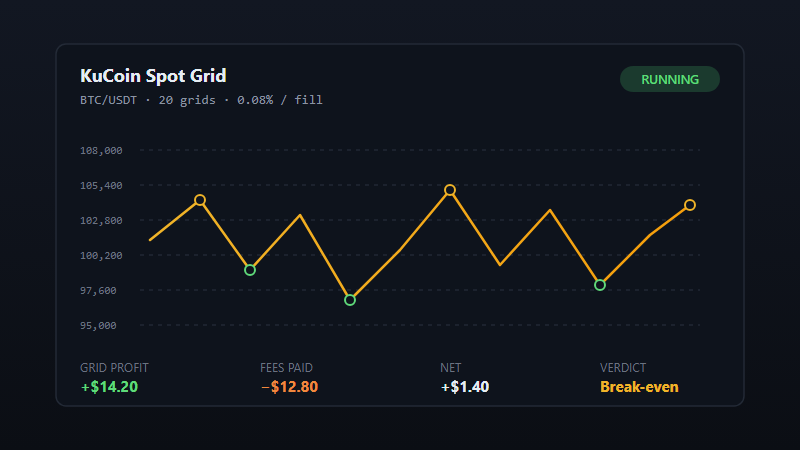
Everyone treats "the bot is free" as the whole story. It isn't. KuCoin doesn't charge a subscription for its spot grid bot, its futures grid bot, or its DCA bot, and that gets repeated in every listicle ranking "free crypto trading bots" as if free means profitable. It doesn't. Free just means the cost moved from a monthly fee to something less visible: the trading fee on every single grid fill, times however many times the bot fires a day.
I've spent the last couple weeks going through KuCoin's actual bot documentation line by line, the same way I did for Bybit's built-in bots and the Pionex futures grid. What follows is the honest mechanical breakdown: how the bots actually work, what they cost, and why the math lands closer to break-even than the marketing suggests.
What KuCoin actually offers
KuCoin's bot suite lives inside the exchange itself, no API keys, no third-party dashboard. You fund your KuCoin trading account and launch a bot directly from the terminal. The lineup includes Spot Grid, Infinity Grid, AI Spot Trend, Grid Spot Martingale, Smart Rebalance, DCA, and Margin Grid on the spot side, plus Futures Grid, AI Futures Trend, Futures Martingale, and DualFutures AI on the derivatives side, according to KuCoin's own trading bot FAQ.
The Spot Grid is the one almost everyone starts with, and for good reason. You set a price range, a grid count, and an allocation, and the bot buys as price falls through each level and sells as it rises back through. KuCoin's help center explanation walks through a plain example: BTC at $29,400, range set from $29,000 to $30,000, split into $100 intervals, so ten grid levels. The bot works those levels mechanically. No prediction, no trend-following, just buy low, sell high, repeat, inside a box you drew yourself.
There's also an "Auto" mode that uses recent price history to suggest a range and grid count for you. Treat it as a rough starting point, not gospel (the same caveat applies to basically every exchange's AI-assisted grid setup I've looked at, Bybit's Aurora AI included).
The fee math nobody puts in the headline
Whether you make money is decided here, not in the strategy.
Spot bot strategies, including Spot Grid, get a 20% discount off KuCoin's standard LV0 fee rate. The base rate is 0.10% maker and 0.10% taker, so with the bot discount you're paying roughly 0.08% per fill instead. That sounds trivial until you remember a grid bot doesn't place one trade, it places dozens.
One important catch buried in KuCoin's own fee rules: KCS fee deductions don't apply to trading bots. If you normally pay fees in KCS to shave your rate down further on manual trades, that discount does not carry over once a bot is placing the orders. The bot-specific 20% discount is the only break you get.
Futures bot strategies work differently. Instead of a variable discounted rate, KuCoin charges a flat 0.06% per trade regardless of your VIP tier, per the trading bot fee rules page. That's actually competitive on paper. It's also flat, which means it doesn't improve even if you're a high-volume trader, and it stacks with funding fees the same way any futures grid does.
Run 15 grid fills a day on a $500 allocation at 0.08% per fill, and you're paying roughly $6/month in fees before the grid has made a cent. A quiet, tightly-ranging week can produce grid profit in that same ballpark. The bot isn't lying about being free. It's just quiet about who actually keeps the spread.
Where the break-even problem comes from
A grid bot's profit is the sum of small spreads captured across many fills. Every one of those fills also pays a fee, so the bot is racing its own transaction costs on every single trade, not just at the end. Narrow your grid to catch more of the day's chop and you multiply fills, which multiplies fees, faster than you multiply captured spread. Widen the grid to reduce fee drag and you catch fewer bounces, so total profit drops too. There isn't a setting that escapes this, only a setting that manages it better or worse.
Then there's the range problem, which every grid bot on every exchange shares. KuCoin's own documentation is honest about it: the bot "struggles during strong trending phases or market crashes when prices move outside the grid range." When price blows through your lower bound, the bot stops. You're left holding an unrealized loss with no bot activity until price comes back or you manually intervene, restart, and lock in whatever loss you were sitting on.
Add those two things together, fee drag on every fill plus dead time whenever the market actually trends, and you get why the honest expectation for a typical KuCoin spot grid user is close to break-even after costs, not the 20-40% APR screenshots that circulate on social media. Those screenshots are almost always cherry-picked windows where the pair happened to range tightly and the person stopped tracking before a trend move wiped the gains.
Futures grid and the funding layer
The futures grid adds a third cost on top of trading fees and the range problem: funding. KuCoin's own FAQ breaks futures grid profit into three components, "Grid Profit + Floating PNL + Funding Fee," which is a more honest disclosure than most competitors give upfront. Funding on perpetuals fires every 8 hours and can run from near-zero to well above 0.05% per interval depending on how one-sided the market is positioned. At any real leverage, a stretch of positive funding against your position can eat a grid's entire realized profit, which is the same arithmetic that caps Pionex's futures grid at low leverage despite its cheaper per-fill fee.
If you're going to run KuCoin's futures grid, check the funding rate on the contract before you launch, not after. It's a five-second check that tells you whether you're fighting an additional headwind on top of the flat 0.06% trading fee.
DCA bot: the one that mostly avoids this problem
KuCoin's DCA bot is mechanically simpler and, honestly, the one I'd point a beginner toward first. It buys a fixed amount on a schedule regardless of price, then exits on a configured profit target. No grid range to blow through, no repeated fee drag from dozens of daily fills, just periodic buys at the standard discounted spot bot rate.
It won't produce the "look at this APR" screenshots either. It's not designed to. It's designed to remove the temptation to time entries, which for most people is worth more than a few extra percentage points of theoretical grid yield.
| Feature | KuCoin Spot Grid | Pionex Futures Grid |
|---|---|---|
| Setup location | Inside exchange, no API keys | Inside exchange, no API keys |
| Trading fee | 0.08% per fill (20% bot discount) | 0.05% per trade |
| Subscription cost | None | None |
| Leverage available | No (spot only) | Yes, adds funding fees |
| AI range suggestion | Yes, Auto mode | Yes, AI grid suggestion |
| Funding fee exposure | None (spot) | Yes, every 8h |
Who this actually fits
AlgoGrade Verdict
Independent ReviewWhat works
- ✓No subscription fee on any bot, only trading fees apply
- ✓20% discount on spot bot fees versus manual LV0 trading
- ✓Runs inside the exchange, no API key management or third-party risk
- ✓Futures grid profit formula is disclosed honestly (grid profit, floating PNL, funding fee, all three named)
- ✓DCA bot is a genuinely low-friction way to accumulate without timing entries
Watch out for
- ✗KCS fee discount does not stack with the bot discount
- ✗Fee drag on frequent grid fills tends to cancel out grid profit in choppy, low-volatility conditions
- ✗Bot goes dead the moment price exits your configured range, same as every grid bot
- ✗Auto/AI range suggestion reflects past volatility, not future moves
- ✗Fee structure competitive but not decisively better than Pionex for the same spot grid job
Best for: Traders who already hold funds on KuCoin and want a no-subscription way to automate spot grid or DCA on a major pair, with realistic break-even expectations after fees
Try KuCoin →Honestly, a 6.3 feels right and not because the bot is badly built. The mechanics are sound, the fee structure is genuinely competitive against Bybit's flat 0.1% and roughly in line with Pionex's 0.05%, and the disclosure around futures funding is better than most exchanges bother with. The problem is structural, not KuCoin-specific: grid bots pay fees on every fill, and for most retail account sizes on a normal pair in normal conditions, those fees plus the inevitable range-exit dead time claw back most of what the grid actually earns. You're not losing money running it. You're also, most of the time, not making much either.
If you're weighing KuCoin against other bot-bearing exchanges, our Bybit vs Bitsgap breakdown and the Bitsgap vs Pionex comparison cover the third-party side of that decision. And before depositing real money on any bot platform, including this one, run through our platform vetting checklist first. It takes ten minutes and it's saved me from at least one bad Sunday.
Try KuCoin →
Worth trying? If you already have funds sitting on KuCoin, yes, start the Spot Grid on a pair you know well with a range no wider than about 8-10% and watch the fee line for two weeks before deciding it's a keeper. If you're choosing an exchange from scratch purely for the bot, the fee math here doesn't beat Pionex by enough to matter.