
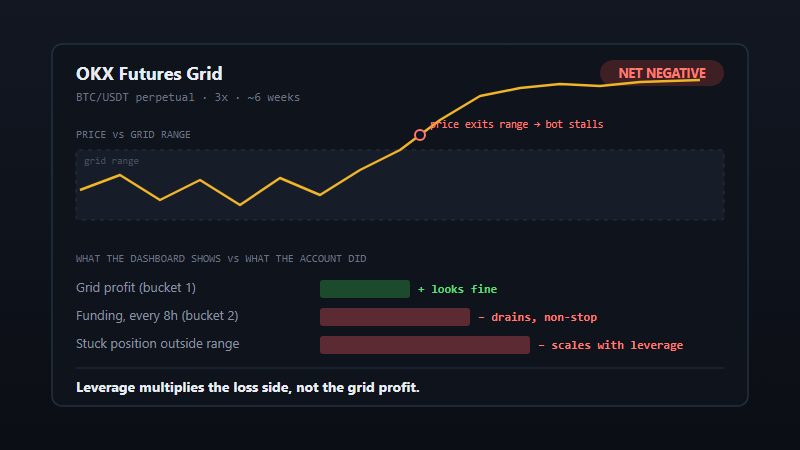
The pitch for a futures grid over a spot grid is that leverage multiplies your profit: same range, same bounces, bigger number at the end. It's the claim behind every futures-grid thumbnail on YouTube, and OKX's own documentation quietly contradicts it. This post walks through what leverage actually multiplies on this bot, using OKX's published mechanics rather than a funded account.
To be clear about what this is: documentation and fee analysis, not a live test. The links go to OKX's own FAQ and fee pages so you can check every claim.
The belief that gets people into this bot
Most people think a futures grid gets you the same buy-low-sell-high mechanic as a spot grid, with leverage scaling the profit on every fill. Same grid lines firing, same spread per bounce, just multiplied by 3x or 5x. Free money, if the spot version already worked.
That's not what leverage multiplies. It multiplies your notional exposure, which multiplies your funding bill and multiplies how badly a trend outside your range hurts. The grid profit per fill is set by your grid spacing and the spread you capture, and that doesn't change with leverage at all. What scales with position size is every cost attached to position size. So leverage amplifies your exposure to the two failure modes that were already the weak points of a spot grid, and leaves the income side where it was.
That single asymmetry is the whole argument, and everything below is just showing where it comes from.
What happens when price leaves your range
Before you set a range, work out what the bot is doing on the day price sits outside it.
A futures grid outside its range stops being a grid and becomes a stuck leveraged position. OKX's futures grid bot FAQ states the mechanism plainly: the bot stops placing new orders once price is outside your configured range, and any position you're still holding "will suffer losses, and might result in forced liquidation if leverage is applied."
So grid income goes to zero. The position stays open. And funding keeps settling in the background, every eight hours, regardless of whether the bot is doing anything useful. There is no pause button short of closing the position manually.
Why funding is the part nobody screenshots
Ask most people what a futures grid costs and they'll say the trading fee per fill, the same answer they'd give for a spot grid. That's two-thirds of the bill.
OKX charges funding on open perpetual positions every eight hours, at 00:00, 08:00 and 16:00 UTC, per OKX's funding fee mechanism page. When the rate is positive longs pay shorts, when negative the reverse. The exchange doesn't keep it, it's a transfer between traders, which sounds neutral until you notice you owe it only if you're holding at the moment the rate settles. A dead grid stuck outside its range holds through every single settlement, which is exactly when it's earning nothing.
There's a second thing worth knowing, and it's an accounting detail with real consequences. Grid profit and funding aren't the same bucket in OKX's reporting: the FAQ separates the buy-sell spread ("grid profit") from everything else, including funding, which lands in what OKX calls "Unpaired PnL." Your dashboard can show a healthy positive grid profit while your account balance goes the other way, because the costs live in a different number than the one the bot proudly displays.
Grid profit is the number the bot shows you. Funding and the stuck position are the numbers that decide your balance. On a leveraged grid they are reported separately, and only one of them is on the headline.
Putting the leverage math together
OKX's documentation spells out the per-cycle profit as sell price minus buy price, times volume, minus both the buy and the sell fee. That formula assumes the grid is cycling. The moment it isn't, the income side of the equation goes to zero while the funding side keeps compounding against a notional you chose to inflate with leverage.
Run it as a comparison rather than a prediction. At 1x, a range-exit costs you the opportunity of the fills you're not getting, plus funding on your capital. At 3x, the same range-exit costs you the same lost fills, plus funding on three times the notional, plus three times the unrealized drawdown on the way. The event is identical. The bill isn't.
| Feature | OKX Futures Grid | Pionex Futures Grid |
|---|---|---|
| Setup location | Inside exchange, no API keys | Inside exchange, no API keys |
| Subscription cost | None | None |
| Funding fee frequency | Every 8 hours (00:00/08:00/16:00 UTC) | Every 8 hours |
| Behavior outside range | Stops placing orders, position stays open and exposed | Stops placing orders, position stays open and exposed |
| Grid profit vs funding reporting | Separated: grid profit and funding tracked in different buckets | Combined in realized/unrealized PnL summary |
| Per-fill trading fee | Standard futures taker/maker tiers | 0.05% flat |
Neither platform has a defense built into the design for a trending market. The difference is in the reporting and the fee schedule, not the failure mode, and I'd rather you knew that before choosing between them on the strength of an APR screenshot. The fee side of that comparison is worked through in the Pionex futures grid review.
Who this is actually for
AlgoGrade Verdict
Independent ReviewWhat works
- ✓No subscription fee, runs inside the exchange with no API key setup
- ✓OKX's disclosure of the profit formula and range-exit risk is honest and specific, not buried
- ✓Works in genuinely range-bound conditions at low leverage, the same as any grid bot
- ✓Fast to set up if you already hold funds on OKX
Watch out for
- ✗Leverage multiplies funding exposure and range-exit losses, not grid profit per fill, the opposite of what most people assume
- ✗Funding compounds every 8 hours on a stuck position with no way to pause it without closing
- ✗Grid profit and funding are reported in separate buckets, so the dashboard can look profitable while the balance falls
- ✗No dynamic range adjustment, so a trend outside your bounds just accumulates cost
- ✗The APR figures shown at setup are grid-profit-only and exclude funding entirely
Best for: Traders who understand futures grids are a range-bound-only tool and will run 1x to 2x with real monitoring, not a hands-off setup
Try OKX →A 5.2 is a below-average grade and the mechanics earn it. OKX hides nothing, its own documentation describes the range-exit behavior and the separate accounting buckets clearly, and the tool does what it says. The score reflects a design with no answer for the condition that breaks it, wrapped in a setup screen that advertises an APR excluding its largest cost.
The fee-drag pattern here rhymes with KuCoin's bot suite: grid bots race their own costs on every fill, and funding is a third cost layer that only appears on the futures version. If you want the mechanics of building a bot with actual risk controls rather than trusting a stock exchange feature, the build-in-public bot journey documents that, funding and range problems included.
Worth trying? Only at 1x or 2x, only on a pair you'll check daily, and only if you have a plan for the day price leaves your range, decided before it happens rather than after.