
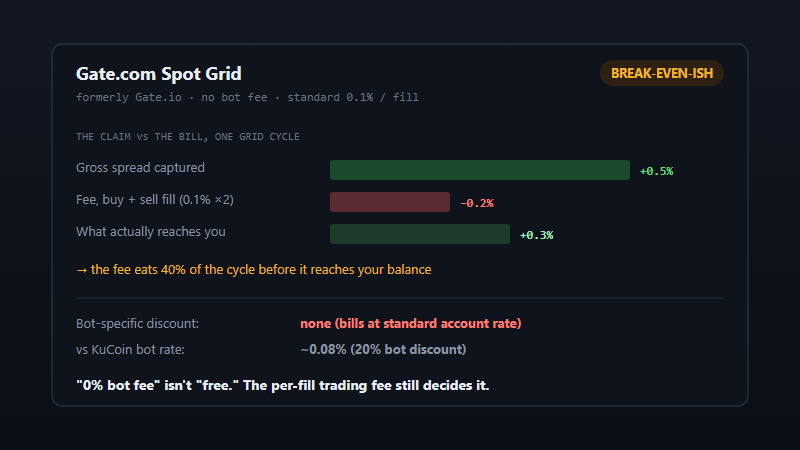
Does a "0% bot fee" claim mean the grid bot is actually free to run? On Gate.com, and on basically every exchange that bundles a grid bot into the platform, the answer is no, and the gap between that marketing line and the real cost is the entire subject of this post.
Quick note on the name, since it trips people up: the exchange formerly known as Gate.io now operates as Gate.com. Same platform, new domain. If you're searching for "Gate.io grid bot," this is the one you mean.
To be upfront about what this is: a documentation and fee-mechanics analysis of Gate.com's spot and futures grid bots, not a live test with a funded account. I looked at the exchange's own help center, its VIP fee tiers, and its published grid bot mechanics, and worked through the arithmetic from there. Where I show numbers, they're a labelled worked example, not a claimed result.
The claim that gets people signing up
Gate.com doesn't charge a subscription for its Spot Grid, Infinite Grid, or Futures Grid bots. No monthly fee, no per-bot rental, launch it straight from the exchange interface once you've funded an account. That's the pitch, and it's technically true. It's also the same pitch every exchange-native bot makes, from KuCoin's suite to OKX's futures grid, and I've now been through enough of these to know that "free" is doing a lot of quiet work in that sentence.
Here's the actual mechanic, straight from the exchange's own grid trading guide: the bot's algorithm is built so it only places a completed round when the grid profit on that cycle exceeds the trading fee it will pay. That's a genuinely honest design choice, and it means a single grid fill can't lose money to fees by itself. But it says nothing about your total return, because a bot that only takes profitable-looking fills can still fire dozens of times a day, and dozens of small, barely-profitable fills add up to a small number a lot faster than they add up to a meaningful one.
Whether Gate.com charges a bot fee is the wrong thing to ask. What matters is the standard trading fee the bot pays on every single fill, and how that compares to the spread you're actually capturing. That's the number that decides whether 30 days of grid activity nets you something or nets you a rounding error.
What the fee schedule actually says
Gate.com's published spot fee schedule starts at 0.1% maker and 0.1% taker at the base VIP0 tier, stepping down as 30-day volume or GT token holdings climb the ladder, down toward 0% maker at the top VIP tiers. (Worth flagging: a few third-party fee trackers list the base spot rate as 0.2% flat instead of 0.1%, which suggests either a lite-tier account type or stale data on those sites, since the exchange's own tiered fee documentation and its VIP program blog post both point to 0.1% as the standard base rate. I couldn't get a live fetch of the fee page to settle the discrepancy definitively, since gate.com blocked automated access on every page I tried, so treat the 0.1% figure as the best-supported number from official sourcing rather than a confirmed screenshot.)
On top of the VIP tier rate, Gate.com lets you pay fees in its native GT token for an additional discount, commonly cited in the 20% range depending on the tier you're already at. Grid bots, per the exchange's own documentation, don't get a separate bot fee schedule at all: a grid bot trade is a regular spot (or futures) order, billed at whatever your account's standard rate happens to be. There's no bot-specific discount and no bot-specific markup. You're paying exactly what you'd pay clicking buy and sell manually, just automated and repeated far more often than a manual trader would bother doing.
That's actually a fair, uncomplicated design. It also means the fee-drag math is unavoidable, because unlike KuCoin (which knocks 20% off its base rate specifically for bot strategies), Gate.com gives you no bot-specific break at all. Your only lever for a cheaper fee is the same VIP ladder or GT discount any manual trader has access to.
A worked example, not a result
Say you're running a $500 allocation on a spot grid with 20 levels across a 10% range, so each grid step is worth roughly 0.5% of the range. At the 0.1% base taker rate with no GT discount, a completed round trip (one buy fill, one matching sell fill) costs you roughly 0.2% in fees. If your grid spacing captures, say, 0.5% gross per completed cycle, the fee eats 40% of that cycle's gross profit before it reaches your balance. Run 10 completed cycles in a week on a tightly ranging pair and you've paid away roughly 40% of the week's gross spread to the exchange, not to the market.
Widen the grid and each cycle captures more spread relative to the fixed fee, so the fee eats a smaller share, but you also get fewer completed cycles because price has to travel further between fills. Narrow the grid and you flip that trade the other way. There's no grid spacing that escapes this relationship, only one that manages the tradeoff better or worse for the specific pair and volatility you're trading. This is the identical structural math behind KuCoin's spot grid, which nets a comparable effective rate after its 20% bot discount, and it's the same reason grid bots as a category tend to land near break-even for most retail account sizes rather than the 20 to 40% annualized figures that circulate on social media.
| Feature | Gate.com Spot Grid | KuCoin Spot Grid |
|---|---|---|
| Setup location | Inside exchange, no API keys | Inside exchange, no API keys |
| Base spot fee (VIP0) | 0.1% maker / 0.1% taker | 0.1% maker / 0.1% taker |
| Bot-specific fee discount | None, bills at standard account rate | 20% off base rate for bot strategies |
| Native token fee discount | GT token, roughly 20% off | KCS discount does not apply to bots |
| Subscription cost | None | None |
| AI range suggestion | Yes, AI Smart Grid backtests 7 days | Yes, Auto mode |
That comparison is closer than it looks at first glance. KuCoin's bot-specific discount brings its effective rate to roughly 0.08% per fill, while Gate.com's GT discount (available to any account, not just bots) can land in a similar range if you're already holding and spending GT. Neither exchange gives you a fee edge large enough to change the underlying arithmetic, it's a wash between them, and the deciding factor for most people will be which exchange they already trust with custody, not which grid bot shaves off an extra few basis points.
The futures grid adds a cost the spot version doesn't have
Gate.com's Futures Grid runs the same buy-low-sell-high logic on perpetual contracts instead of spot pairs, with leverage available and the ability to run in a "neutral," long, or short starting mode. The base futures fee schedule sits lower than spot, 0.02% maker and 0.05% taker at the VIP0 tier per Gate.com's published futures fee table, which sounds like a straightforward upgrade. It isn't, for the same reason it isn't on any exchange's futures grid.
A leveraged perpetual position settles funding on a fixed schedule, every 8 hours, regardless of whether the grid bot is doing anything useful that day. If the bot's position gets stuck outside its configured range during a trend (which is exactly when it stops earning grid profit), it keeps paying or receiving funding the entire time it sits there. I went through this same mechanic in detail in the OKX futures grid review: leverage doesn't multiply your grid profit per fill, it multiplies your funding exposure and how badly a range breakout hurts. Gate.com's futures grid has no structural defense against that failure mode that OKX's or KuCoin's doesn't also lack. It's the same tool with a different fee sticker.
I'll admit I can't tell you exactly how Gate.com's dashboard separates grid profit from funding and floating PnL in its reporting, since I couldn't get a working fetch of the futures grid bot's specific help pages to check (every gate.com URL I tried returned a 403, which is its own small red flag: an exchange whose own documentation is hard for automated tools, and by extension search engines, to index isn't doing itself any favors on the trust front). If you're running the futures version, don't take my word for how the numbers get split, check the position detail screen yourself before you decide the grid profit figure is the whole story.
The bot's own logic guarantees each fill nets more than its fee. It says nothing about whether the whole strategy nets you anything after volume, range exits, and (on futures) funding are added back in.
Who this actually fits
AlgoGrade Verdict
Independent ReviewWhat works
- ✓No subscription fee on spot or futures grid, only standard trading fees apply
- ✓Grid logic is disclosed honestly: a fill only completes if grid profit exceeds the fee, so you can't lose to fees on a single cycle
- ✓Base fee schedule (0.1% spot, roughly 0.02%/0.05% futures) is competitive with KuCoin and OKX
- ✓AI Smart Grid gives a documented, backtested starting range instead of guessing manually
- ✓GT token discount is available to any account, not locked behind a bot-specific tier
Watch out for
- ✗No bot-specific fee discount, unlike KuCoin's 20% off for bot strategies specifically
- ✗Fee drag on frequent grid fills still tends to cancel out most grid profit in choppy, low-volatility conditions
- ✗Futures grid carries the same funding-fee and range-exit exposure as every other exchange's futures grid
- ✗Official documentation was largely unreachable through automated fetching during this review, a minor but real transparency gap
- ✗Conflicting third-party fee figures (0.1% vs 0.2% base) suggest Gate's own fee page isn't as easy to pin down as it should be
Best for: Traders who already hold funds on Gate.com and want a no-subscription way to automate spot grid trading on a major pair, with realistic break-even expectations after fees
Try Gate.com →A 6.0 is a fair, unremarkable grade, and that's the honest takeaway here: Gate.com's grid bot is mechanically sound and priced in line with its competitors, but it isn't a decisive upgrade over KuCoin or OKX for the same job. The fee schedule is competitive, the "fee-safe fill" logic is a genuinely good design choice, and none of that changes the structural math every grid bot on every exchange is stuck with: fees on every fill, dead time on every range exit, and funding as a third cost layer the moment you add leverage.
If you're comparing exchange-native bots before picking one, run through our platform vetting checklist first, and the KuCoin trading bot review and OKX futures grid review cover the two closest comparisons in more depth. If you'd rather see what building your own bot from scratch actually involves, including funding and range problems the hard way, the build-in-public bot journey documents that too.
Try Gate.com →
Worth trying? If you're already on Gate.com, sure, start a spot grid on a pair you know well with a range under 10% and track the fee line for two weeks before calling it a keeper. If you're picking an exchange from scratch purely for the bot, the fee math here doesn't beat KuCoin or Pionex by enough to matter either way.