
Is Pocket Option rigged? That's the search that brings most people to this topic, and I get why. You deposit $200, lose four trades in a row right at expiry, and your brain goes straight to "the broker did this to me." Sometimes that instinct is worth listening to. But almost nobody asks the question underneath it first. Even if Pocket Option ran the most honest binary options desk on earth, would you still lose money over time?
The answer is yes, you would lose over time given enough trades, and that's not me hedging, it's just the arithmetic of how these contracts pay out. It's also the part of the whole conversation that gets buried under all the manipulation debate, which is a shame because it's the part that actually matters most.
The math that doesn't care if anyone's cheating
A typical binary option pays out somewhere between 70% and 90% on a winning trade. Lose, and you don't lose 70-90%, you lose 100% of your stake. That asymmetry is the entire business model, and it's true whether the broker is a Wall Street bank or a website that launched last year with a logo made in Canva.
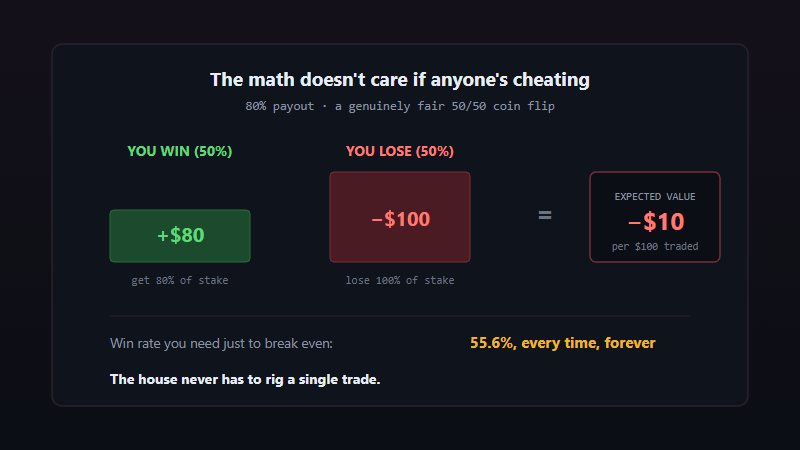
Do the breakeven math on an 80% payout. Win a trade, you get $80 back on a $100 stake (plus your $100, so $180 total). Lose, you get zero. For a coin-flip 50/50 market, your expected value per trade is:
(0.5 x $80) - (0.5 x $100) = $40 - $50 = -$10 per $100 traded, on a genuinely fair coin flip.
To break even at an 80% payout, you don't need to win 50% of trades. You need to win roughly 55.6% of the time, every time, forever, just to net zero before any fees. Above that, you're profitable. Below it, and every honest 50/50 outcome bleeds you slowly. The house doesn't need to rig a single trade. The payout structure already guarantees the math skews against you.
I've had this exact conversation with a reader who emailed me in May after losing about 60% of a small account on 1-minute EUR/USD binaries over three weeks. He wasn't really asking about strategy, he was asking if the broker's charting was fake, because his losing trades all seemed to reverse right after his position closed. It's possible, though probably not for the reasons he assumed, and I'll get to why later. But even in the scenario where every single price tick he saw was completely real and unmanipulated, he was still playing a game engineered to take his money slightly faster than a coin flip would. That's the part that never gets a headline.
Why OTC pairs are structurally different, not just suspicious
Who is quoting the price you're trading against on a Saturday afternoon? That matters more than whether the broker is cheating.
During normal market hours, a EUR/USD quote traces back to real interbank liquidity. Nobody controls it alone. But binary options platforms, Pocket Option included, offer "OTC" pairs on weekends and off-hours specifically because the real underlying market is closed. Something still has to generate a tradeable price. That something is the broker itself, running its own synthetic pricing feed.
Sit with what that means structurally. The party quoting you the price is the same party sitting on the other side of your trade, and the same party that profits directly every time you lose. That's not an allegation about any specific company. That's the literal architecture of an OTC binary contract. A regulated futures exchange separates the exchange (who sets the market) from your counterparty (who takes the other side of your trade) from the clearinghouse (who guarantees settlement). OTC binary trading collapses all three roles into one entity, and that entity has a direct financial interest in your outcome.
You don't need proof of misconduct to know that's a bad setup. A casino that also deals the cards, sets the odds, and pays out the winnings has a conflict of interest even if it never once cheats. Whether any specific platform crosses from "structurally conflicted" into "actively rigging trades" is a different, harder-to-prove question. Which brings us to Pocket Option specifically.
What Reddit actually says about Pocket Option
I want to be careful with this section, because it's the one place in this post where I'm reporting what other people claim, not what I can independently verify.
Across trading forums and Reddit threads (r/Forex and general trading subreddits turn this topic over regularly), a recurring pattern of user reports shows up. Traders allege that OTC pairs on Pocket Option and similar platforms show sudden wicks or price spikes right around option expiry, specifically timed to flip a trade from winning to losing in the final seconds. Others report that "signal" services and Telegram groups pushing Pocket Option referral links have a suspiciously consistent record of producing losing calls once you start paying for them. Some describe getting a string of near-miss losses (price finishing one pip past the strike, over and over) that felt statistically off to them.
None of this is something I can confirm. I haven't run a controlled test comparing Pocket Option's OTC feed against an independent price source tick for tick, and as far as I can tell nobody has published one that would hold up. These are unverified but widely repeated user reports, not proven fraud, and I'm not going to state as fact that Pocket Option manipulates prices. What I can say is that the structural setup described above (broker sets the price, broker is your counterparty, broker profits from your loss) is exactly the kind of arrangement that makes these complaints plausible regardless of whether they're literally true in every case. The CFTC's own fraud alert on binary options, which I'll get to next, lists "manipulation of the trading software to distort binary options prices" as a documented pattern across offshore platforms generally, not a claim specific to any one broker.
Why regulators moved to ban this, not just warn about it
This is the part that should carry more weight than any Reddit thread, because it's not an allegation, it's the outcome of regulators independently reaching the same structural conclusion.
The EU's securities regulator, ESMA, banned the sale of binary options to retail investors starting in 2018. Their official reasoning is worth reading directly because it doesn't hedge: ESMA cited a "structural expected negative return and embedded conflict of interest between providers and their clients" as grounds for a full prohibition, not just a warning label. That's a regulator saying, in formal language, exactly what the payout math above shows in numbers.
The UK's FCA followed with its own permanent ban, effective 2 April 2019, estimating it would save UK retail consumers up to £17 million a year in losses. And in the US, the CFTC and SEC jointly issued an investor alert on binary options fraud that specifically names offshore, unregistered platforms as the recurring source of complaints, including software manipulation, refused withdrawals, and identity theft from KYC documents submitted to sites with no real regulatory oversight. Only three US exchanges are legally allowed to offer binary options at all: Cantor Exchange, CME, and Nadex. Pocket Option is not one of them, and it doesn't accept US clients as a regulated entity for that reason.
Three separate regulators, working independently, all landed on the same conclusion: the product itself is the problem, not just the bad actors selling it. That's a much stronger signal than any individual complaint thread.
So what do you actually do with this
If you're trading binary options right now and winning, honestly, good for you, but ask yourself if your win rate is comfortably above that 55.6% breakeven line on your actual payout percentage, sustained over hundreds of trades, not a lucky Tuesday. Most people who've actually tracked their numbers over a real sample size aren't.
If you want exposure to fast, leveraged, algorithmic trading without handing a single counterparty both the pricing and the payout, that's a different category of product entirely. Regulated futures exchanges, transparent fee structures, and bots that execute on real order books are the honest version of "I want to trade short-term price movement systematically." We've tested plenty of those. If you're evaluating a new platform in that category, run it through our platform vetting checklist before depositing anything, and if you're specifically comparing exchange-native tools with transparent fee math, our OKX futures grid bot review and KuCoin bot review show what a fair fight with the market actually looks like, wins and losses both, math you can verify yourself instead of a countdown timer you can't.
I'm not going to tell you binary options brokers are all frauds. I can't prove that and I'm not making that claim about Pocket Option specifically. What I can tell you is that you don't need a conspiracy to explain why the money mostly flows one direction. The payout structure does that job on its own.